How to Think Straight About Psychology by Keith E. Stanovich
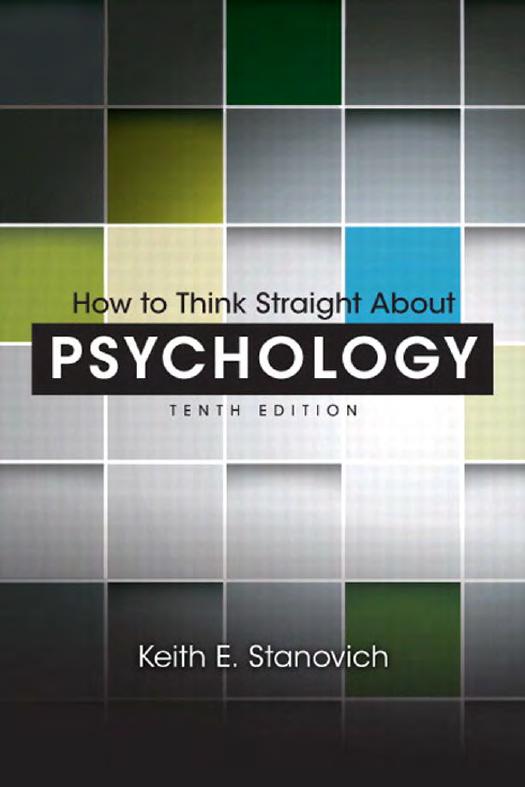
Author:Keith E. Stanovich
Language: eng
Format: epub, pdf
Publisher: Pearson
Published: 2012-05-31T04:00:00+00:00
Applications of Psychological Theory
Once we understand that the purpose of most research is to develop theory rather than to predict events in a specific environment and that the findings of most research are applied indirectly, through theory, rather than directly in a specific environmental situation, we can legitimately ask how much application through theory has been accomplished in psychology. That is, have psychology’s theories been put to this test of generality?
On this point, we must admit that the record is mixed. But it is wise to keep psychology’s diversity in mind here. It is true that some areas of research have made only modest progress along these lines. However, other areas have quite impressive records of experimentally derived principles of considerable explanatory and predictive power.
Consider the basic behavioral principles of classical and operant conditioning. These principles and their elaborating laws were developed almost entirely from experimentation on nonhuman subjects, such as pigeons and rats, in highly artificial laboratory settings. Yet these principles have been successfully applied to a wide variety of human problems, including the treatment of autistic children, the teaching of large amounts of factual material, the treatment of alcoholism and obesity, the management of residents in psychiatric hospitals, and the treatment of phobias, to name just a few.
The principles from which these applications were derived were identified precisely because the laboratory experimentation allowed researchers to specify the relationships between environmental stimuli and behavior with an accuracy not possible in a natural situation, in which many behavioral relationships may operate simultaneously. As for the use of nonhuman subjects, in many cases theories and laws derived from their performance have provided good first approximations to human behavior (Vazire & Gosling, 2003). When humans were examined, their behavior often followed laws that were very similar to those derived from other animals. Findings such as these should hardly surprise anyone today, when just about every medical advance in the treatment of human illness has involved data from animal studies. For example, research with animals has contributed to developments in behavioral medicine; stress reduction; psychotherapy; rehabilitation of injured and handicapped individuals; studying the effects of aging on memory; methods to help people overcome neuromuscular disorders; understanding drug effects on fetal development; traffic safety; and the treatment of chronic pain (Gosling, 2001; Kalat, 2007; Michaels, 2008; Zimbardo, 2004). Recent research with monkeys has led to some real advances in understanding the underlying basis of phobias and anxiety disorders (Mineka & Zinbarg, 2006).
In fact, the it’s-not-real-life argument has been used misleadingly to denigrate the results of animal research—often for political reasons. For example, lobbyists for polluting companies often put forth the argument that the evaluation of the human risk of cancer-causing agents is invalid if based on animal studies. However, in a 1988 study of 23 carcinogenic agents (benzene, asbestos, etc.) by a team of scientists, it was found that estimated death rates from animal studies were quite close to estimates from epidemiological studies of humans (Finkel, 1996).
Psychologists studying perceptual processes have made impressive theoretical
Download
How to Think Straight About Psychology by Keith E. Stanovich.pdf
This site does not store any files on its server. We only index and link to content provided by other sites. Please contact the content providers to delete copyright contents if any and email us, we'll remove relevant links or contents immediately.
Rewire Your Anxious Brain by Catherine M. Pittman(18638)
Talking to Strangers by Malcolm Gladwell(13342)
The Art of Thinking Clearly by Rolf Dobelli(10444)
Mindhunter: Inside the FBI's Elite Serial Crime Unit by John E. Douglas & Mark Olshaker(9313)
Becoming Supernatural by Dr. Joe Dispenza(8196)
Change Your Questions, Change Your Life by Marilee Adams(7753)
Nudge - Improving Decisions about Health, Wealth, and Happiness by Thaler Sunstein(7689)
The Road Less Traveled by M. Scott Peck(7592)
The Lost Art of Listening by Michael P. Nichols(7487)
Mastermind: How to Think Like Sherlock Holmes by Maria Konnikova(7313)
Enlightenment Now: The Case for Reason, Science, Humanism, and Progress by Steven Pinker(7305)
Win Bigly by Scott Adams(7183)
The Way of Zen by Alan W. Watts(6594)
Daring Greatly by Brene Brown(6501)
Big Magic: Creative Living Beyond Fear by Elizabeth Gilbert(5753)
Grit by Angela Duckworth(5598)
Ego Is the Enemy by Ryan Holiday(5412)
Men In Love by Nancy Friday(5231)
The Laws of Human Nature by Robert Greene(5167)
